
March 15, 2026
UGC creator rates in 2026: what brands should expect to pay

If you’re running paid social for an ecommerce brand or managing creator budgets at an agency, you already know: UGC pricing is a mess. One creator quotes €120 for a video. The next wants €800 for what looks like the same deliverable. And half the time, you’re not even sure what you’re comparing—because scope, usage rights, and add-ons are all bundled differently.
This guide breaks down what UGC creators actually charge in 2026 across the European market (with a focus on Germany), what drives the price gaps, and how to budget without guessing.
The 2026 Rate Landscape in Europe
In the European market, UGC video pricing in 2026 typically ranges from €150 to €2,500 per video. That’s a wide spread—because experience, production quality, and usage rights create massive variation. According to recent industry data, around 68% of brands in the DACH region pay between €300 and €800 per UGC video.
Here’s a more useful breakdown by creator tier:
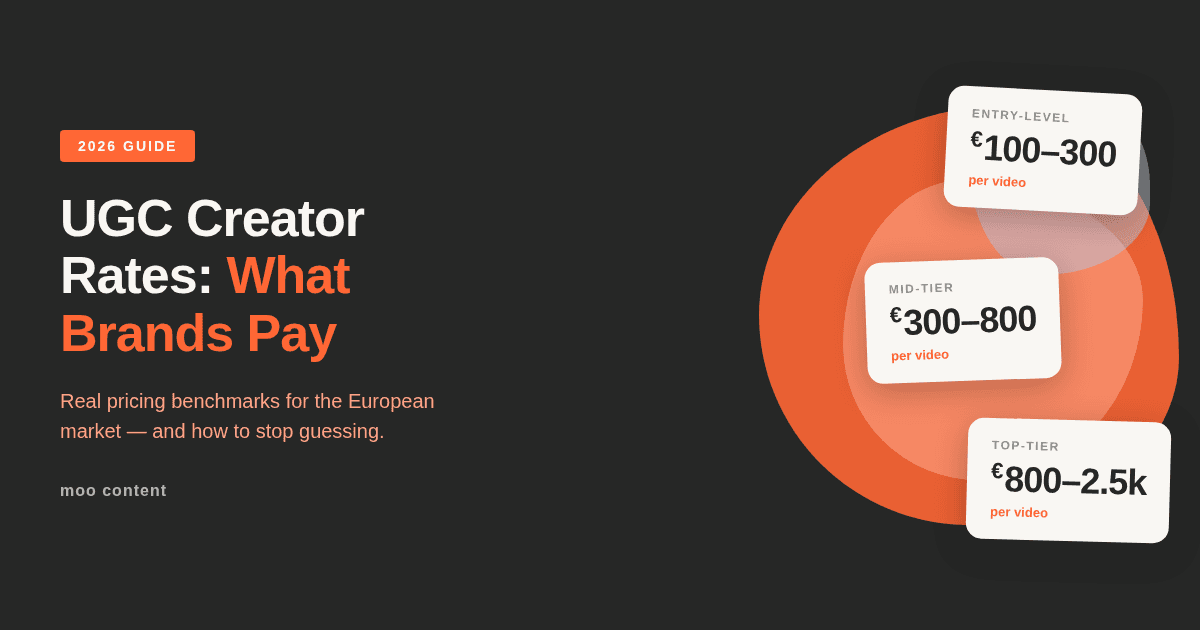
Entry-level creators (simple vertical videos, minimal editing): €100–€300 per video
Mid-tier creators (stronger production value, niche expertise): €300–€800 per video
Top-tier creators (proven ROI track record, advanced editing, scripting): €800–€2,500+ per video
Prices have been trending upward in the DACH market—expect roughly 10% annual increases—even as global averages dipped due to an influx of new creators and AI-generated content tools. European brands tend to pay more for local-language creators with authentic production quality, and that premium isn’t going away.
What Actually Drives the Price
The base rate is only part of the equation. These are the variables that shift your final number:
Usage rights are the biggest multiplier. Paid ad usage for 30 days adds €200–€500 per video. A full buyout with perpetual rights? That’s €1,000+ on top. If you’re running performance ads, this is non-negotiable—and it’s where most brands underbudget.
Our tip: You don’t need to buy long usage rights upfront. Start with a shorter window, test the creative, and extend later if it performs. Too many brands lock in expensive perpetual rights on ads that never scale. Put that budget into ad spend instead—you’ll get more out of it.
Platform and format matter. TikTok and Reels content tends to cost more than a basic product demo because of the editing effort and the performance value it delivers for paid channels.
Bundles help. Booking 3+ videos from one creator typically saves you 15–20%. A common European package sits around €400 for three videos with organic usage.
Add-ons add up. Hook variations, subtitles, music licensing, raw footage, rush delivery—these quietly inflate your cost if you’re not scoping them upfront.
The Pricing Problem (and Why It’s Costing You)
Most brands go through the same painful loop: they DM creators on Instagram, get wildly different quotes, have no benchmark to compare against, negotiate awkwardly, and end up either overpaying or losing good creators who feel lowballed. Multiply that by ten creators per campaign and you’re spending more time on pricing than on creative strategy.
The issue isn’t that UGC is expensive—it’s that there’s no shared pricing language. Everyone’s guessing.
This is exactly what moo content was built to solve.
How MOO Content Makes Pricing Simple
moo content is a price-led marketplace, which means pricing is built into the workflow from day one. Here’s how it works:
1. You define your project scope. Number of videos, hook variations, usage rights, subtitles, music—everything that affects the cost gets specified upfront so there are no surprises later.
2. The AI Pricing Calculator gives you a market benchmark. Based on your specific deliverables, usage rights, turnaround time, add-ons, and industry category, our AI generates a fair market price. It’s not setting the price for you—it’s showing you what comparable projects actually cost so you can budget with confidence.
3. You invite a creator and see a personalised price. When you find a creator you like, the calculator also factors in their experience and rates—so you see what that specific creator would cost for your brief. You decide what to offer. No guessing, no awkward DM negotiations.
4. The creator accepts, counters, or declines. Both sides work with the same number. Creators see the total brand-facing price, the 20% platform commission, and their net payout—instantly. If the offer doesn’t work, they can propose a new price. You agree, adjust, or move on. No friction, no hidden fees.
Because every transaction feeds back into the system, the AI benchmarks get sharper over time. The more brands and creators use the platform, the more accurate the pricing becomes.
A Quick Budgeting Framework
If you’re planning your next quarter of UGC content for the European market, here’s a rough starting point:
Performance testing (5–10 videos/month, entry-to-mid creators): budget €750–€3,000/month
Scaling winners (ongoing creator relationships, ad usage rights included): budget €3,000–€8,000/month
Full-funnel programs (multiple creators, formats, and platforms): €8,000+/month
These ranges shift based on your vertical, volume, and rights needs. The best way to stretch your budget further is to work within a system that handles pricing, sourcing, and collaboration in one place—so you’re not stitching together spreadsheets, DMs, and invoices across five different tools.
Stop Guessing. Start Getting Better Content, Faster.
UGC pricing doesn’t have to be a black box. moo content is a full ecosystem where you source creators, get AI-powered pricing benchmarks, collaborate on content, and manage everything from brief to final delivery—all in one place. Whether you’re a brand sourcing your first batch of creator videos or an agency managing content across ten clients, it’s built to help you move faster, spend smarter, and get better results.
See for yourself how it works → moocontent.com