
May 14, 2026
How Much Content Do You Actually Need for Paid Social? (Powerful 2026 Growth Guide)

Why Most Brands Fail at Paid Social (And How to Fix It)
Most brands aren’t failing at paid social because their ads are bad.
They’re failing because they don’t produce enough creative content to keep testing, learning, and improving.
That’s the real bottleneck.
On platforms like Meta and TikTok, ads don’t last long. Audiences scroll fast, trends change daily, and attention spans are shrinking.
Even a high-performing ad will eventually:
Lose engagement
Drop in click-through rate (CTR)
Increase cost per click (CPC)
Reduce return on ad spend (ROAS)
This is known as creative fatigue.
So instead of asking:
“Is this ad good?”
You should be asking:
“Do we have enough content to keep testing every week?”
Because success in paid social is no longer about one winning ad.
It’s about building a system that produces winners consistently.
The Old Content Model Is Too Slow
Traditional marketing followed a predictable cycle:
Plan a campaign
Develop a concept
Shoot polished assets
Run ads for months
That worked before.
But today’s paid social environment moves too fast.
By the time your campaign is live:
Trends may have changed
Competitors may have adapted
Audiences may already be bored
The result?
Performance declines—not because the idea was bad, but because it stopped being fresh.
👉 Paid social doesn’t reward perfection anymore.
👉 It rewards speed, volume, and iteration.
How Much Content Do You Actually Need for Paid Social?
There’s no universal number—but most brands need more than they think.
Here’s a simple benchmark based on growth stage:
Small Brands (Testing Phase)
5–10 UGC videos
5–10 static ads
10–20 variations
Total: 20–40 assets/month
Goal: Learn what works
Focus on:
Hooks
Messaging
Formats
Audience reactions
Growing Brands (Consistent Ad Spend)
10–15 UGC videos
10–20 static ads
20–40 variations
Total: 40–75 assets/month
Goal: Scale stability
This allows you to:
Replace fatigued ads quickly
Test new angles
Avoid relying on one “winner”
Scaling Brands (Multi-Product or Global)
20–40 UGC videos
20–40 static ads
50–100+ variations
Total: 90–180+ assets/month
Goal: Build a creative engine
At this level, content becomes infrastructure, not just marketing output.
What Counts as “More Content”?
More content doesn’t mean more expensive production.
It means more testable variations, such as:
New hooks
Different first frames
Alternative CTAs
Fresh creators
New headlines
Updated formats
Even small tweaks can unlock performance gains.
👉 Each variation = a new learning opportunity.
Why UGC Alone Is Not Enough
User-generated content (UGC) is powerful—but it’s only part of the equation.
A strong paid social strategy combines:
UGC Videos
Build trust
Show real experiences
Feel native to platforms
Static Ads
Deliver clear messaging
Test offers quickly
Scale efficiently
Creative Variations
Enable rapid testing
Improve insights
Extend ad lifespan
The winning formula:
UGC = authenticity
Statics = speed
Variations = learning
Together, they create sustainable growth.
What Should You Test in Paid Social Creative?
To make content volume effective, structure your testing.
Key Variables to Optimize:
Hooks: What grabs attention fastest?
Creators: Who builds trust?
Angles: Price, pain point, identity, transformation?
Formats: Testimonial, demo, explainer?
First Frames: What stops the scroll?
Offers: Discounts, bundles, guarantees?
CTAs: Urgency vs education vs soft sell?
The more you test, the faster you learn.
The Big Shift: From Campaigns to Creative Supply
Old approach:
Launch
Wait
Analyze
Refresh later
New approach:
Create
Test
Learn
Iterate
Repeat
This is called a creative supply system.
And it’s the foundation of modern paid social success.
Why Creative Volume Is Your Competitive Advantage
Creative volume allows you to:
Discover winning ads faster
Reduce risk of fatigue
Improve campaign efficiency
Scale with confidence
Brands that win aren’t guessing.
They’re testing continuously.
FAQs About Paid Social Content Volume
1. How often should I refresh paid social ads?
Every 2–4 weeks, depending on performance and audience frequency.
2. What is creative fatigue?
It’s when users see the same ad too often, causing performance to drop.
3. Is UGC better than traditional ads?
UGC often performs better for engagement, but combining formats works best.
4. How many ads should I test at once?
At least 5–10 variations per campaign for meaningful insights.
5. Do small brands need high production quality?
No—authenticity and testing matter more than polish.
6. What’s the biggest mistake in paid social?
Not producing enough creative variations.
Conclusion: The Real Key to Paid Social Growth
The question is no longer:
“Can we make one great ad?”
The real question is:
“Can we consistently produce enough content to keep learning?”
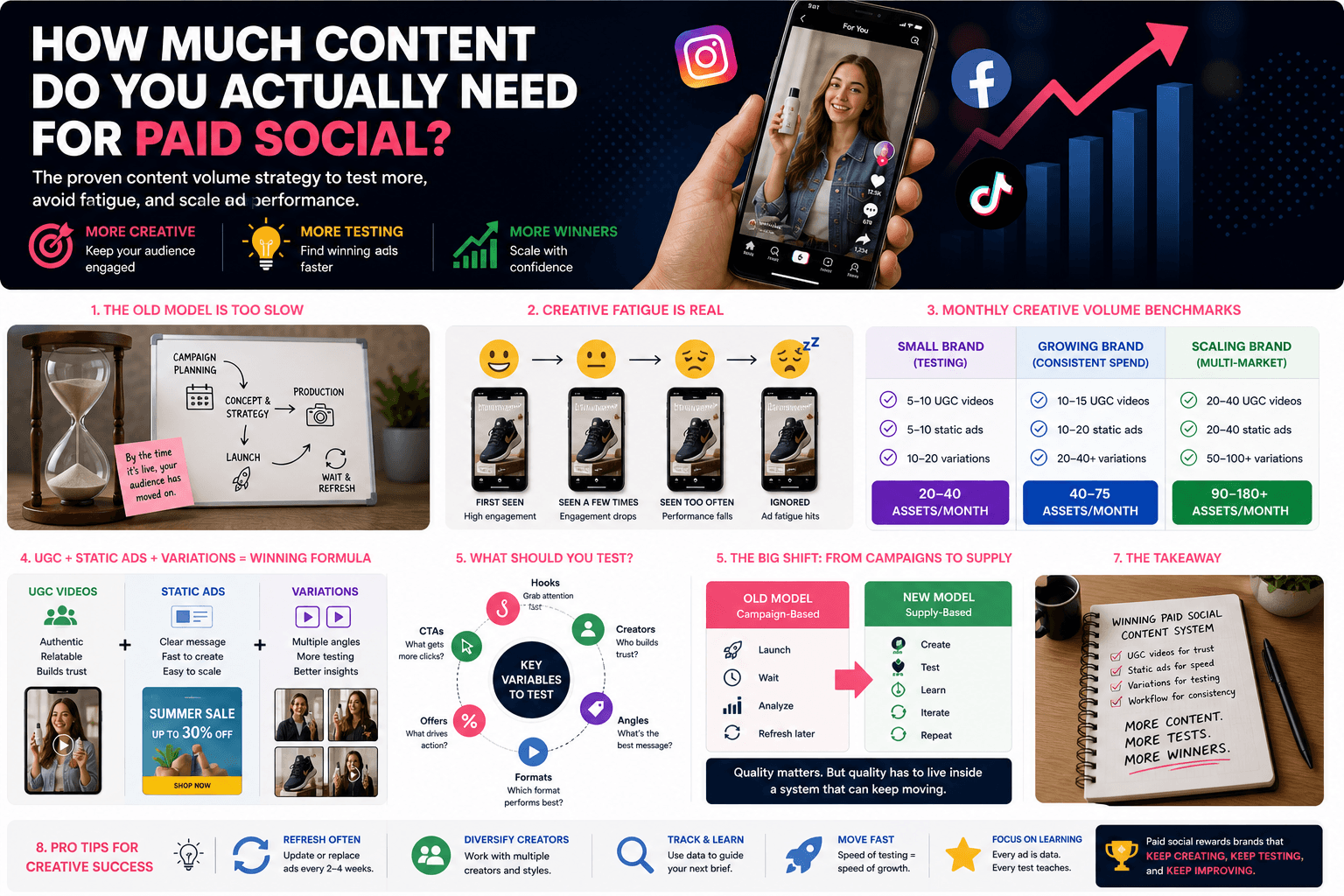
Your Paid Social Content System Should Include:
UGC videos → Trust
Static ads → Speed
Variations → Testing
Workflow → Consistency
Because paid social success comes down to:
👉 Volume
👉 Speed
👉 Iteration
Not perfection.